
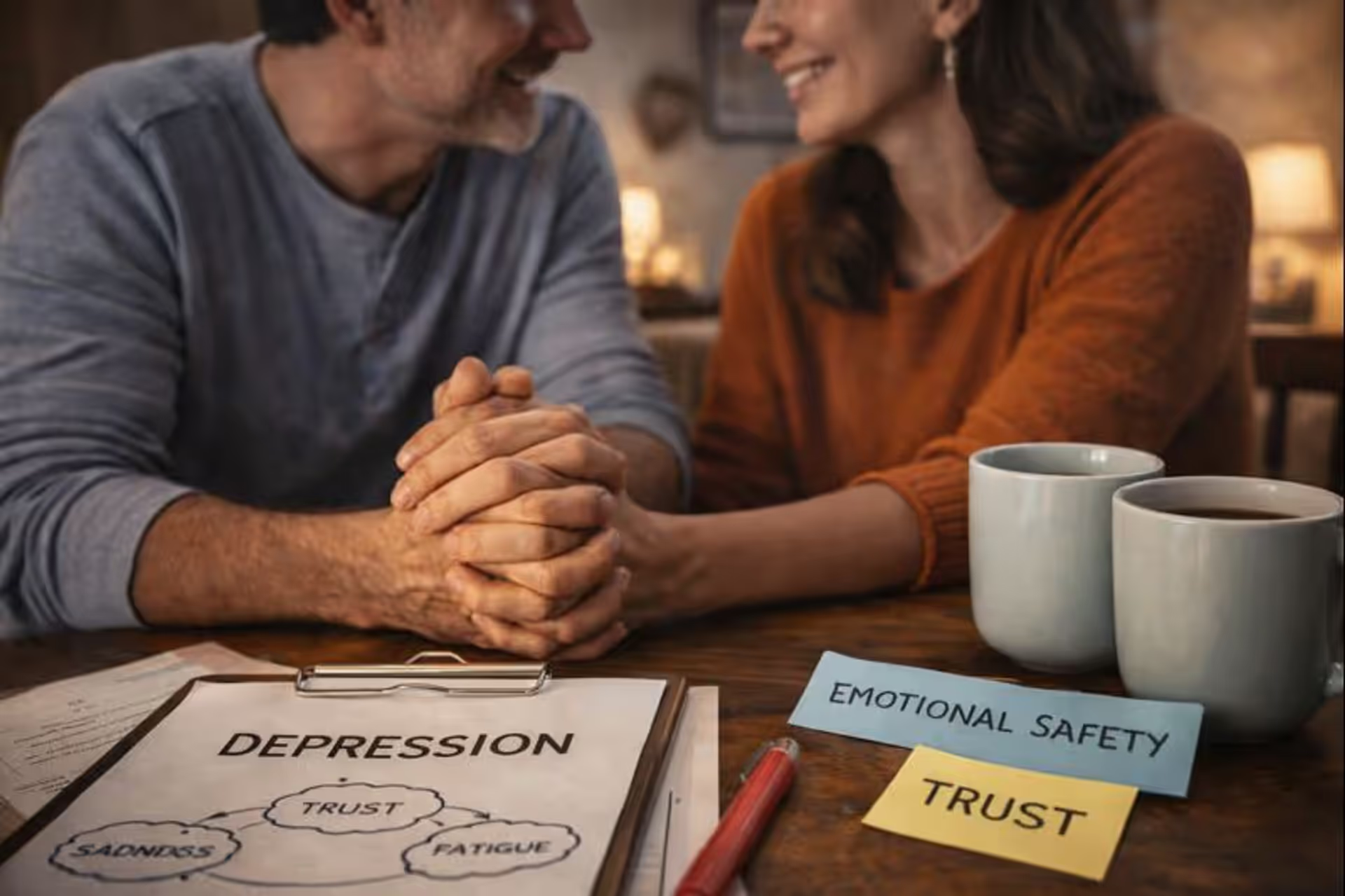
Healthy Relationships Guide for Every Couple
Healthy Relationships Guide for Every Couple

Content
Content
There is a quiet mythology surrounding love that suggests the right relationship should feel effortless. Two people meet, chemistry ignites, and the rest unfolds like a well-scripted romance. Arguments resolve themselves. Needs are intuitively understood. Trust simply exists, sturdy and unquestioned. This mythology is seductive precisely because it promises what we all secretly want: connection without labor, intimacy without vulnerability, love without the terrifying work of being truly known.
But anyone who has sustained a meaningful partnership for more than a few years knows that this mythology is a beautiful lie. Healthy relationships are not discovered; they are built. They are not maintained by luck or fate but by the daily, unglamorous practice of showing up for another person even when it is inconvenient, uncomfortable, or requires admitting that we have been wrong. The couples who last are not necessarily those with the most explosive passion or the fewest conflicts. They are the ones who have learned to communicate with skill, to repair trust after rupture, and to create the emotional safety that allows both partners to grow without fear of abandonment or judgment.
This article explores the foundational pillars of genuinely healthy relationships: the communication skills that transform conflict into connection, the processes by which trust is cultivated and restored, and the creation of emotional safety that allows intimacy to deepen over time. This is not a collection of easy tips or romantic platitudes. It is an exploration of what the research actually shows about how love endures, how trust issues can be navigated, and how two imperfect people can build something that sustains and nourishes them both. The relationship advice offered here is grounded in decades of psychological research, not wishful thinking or cultural myths about soulmates and effortless forever-after.
Understanding What Makes Relationships Healthy
Beyond the Absence of Conflict
Healthy relationships are often misunderstood as those without problems. This misconception leads people to hide difficulties, avoid necessary conversations, and measure their partnerships against an impossible standard of perpetual harmony. In reality, conflict is not only inevitable in intimate relationships but actually necessary for growth. Two distinct individuals with different histories, needs, and perspectives will inevitably see the world differently. The question is not whether conflict will arise but how it will be handled when it does.
Successful long-term relationships are created through small words, small gestures, and small acts.
— John Gottman
What distinguishes healthy relationships is not the absence of disagreement but the presence of certain qualities that allow disagreement to be navigated without lasting damage to the bond. Research from the Gottman Institute, which has studied thousands of couples over decades, identifies several factors that predict relationship success. These include the ratio of positive to negative interactions during conflict, the ability to repair after arguments, the presence of fondness and admiration between partners, and the capacity to accept influence from one another. Notably, the research shows that even happy couples disagree regularly. What matters is how they disagree and what happens afterward.
The Core Elements of Relational Health
Several interconnected elements contribute to relational health, forming an ecosystem where both partners can thrive:
- Emotional attunement refers to the capacity to perceive and respond to a partner's emotional state with sensitivity and care. Attuned partners notice when something is wrong, even when nothing has been explicitly said. They read cues, ask questions, and adjust their behavior in response to their partner's emotional needs. This attunement creates the foundation for emotional support that feels genuine rather than performative. When someone feels truly seen by their partner, trust deepens and intimacy flourishes.
- Mutual respect involves treating a partner as a full human being whose thoughts, feelings, and perspectives have inherent value, even when they differ from our own. Respect shows up in how we speak during disagreements, how we honor boundaries, and how we navigate the inevitable power dynamics that exist in any relationships. Without respect, communication degrades into contempt, trust erodes, and emotional safety becomes impossible.
- Shared meaning refers to the creation of a joint narrative about the relationship itself: its history, its purpose, its values, and its future. Partners who share meaning feel that they are working toward common goals, that their relationship serves something larger than either individual's needs alone. This shared sense of purpose provides resilience during difficult periods and gives the partnership a forward momentum that sustains both partners through inevitable challenges.
- Repair capacity is perhaps the most underappreciated element of healthy relationships. Every couple will experience ruptures, moments when connection is broken by misunderstanding, hurt, or failure to meet each other's needs. The ability to repair these ruptures, to apologize authentically, to accept apologies graciously, and to restore emotional connection after breach, matters more than avoiding ruptures in the first place. Relationships that last are not those without wounds but those with strong healing capacities.
The Art and Science of Communication
Why Communication Fails
Most people believe they communicate reasonably well. Most people are mistaken. Effective communication skills in intimate relationships are far more difficult than they appear and far more nuanced than simply saying what we mean. Communication fails for several predictable reasons that have less to do with vocabulary than with the psychological dynamics underlying our attempts to connect.
First, we often communicate to be right rather than to understand. When conflict arises, the natural instinct is to defend our position, marshal evidence for our perspective, and win the argument. This adversarial stance transforms a partner into an opponent and makes genuine understanding nearly impossible. The goal of effective communication is not victory but connection, and this requires setting aside the need to be right in favor of the desire to comprehend.
Second, we frequently assume that our internal experience is obvious to our partner. We feel hurt and expect them to know they have hurt us. We need space and expect them to intuit this without being told. We have expectations and feel betrayed when those unspoken expectations go unmet. But partners are not mind readers. What seems obvious from inside our own experience may be completely invisible from the outside. Good communication skills include the willingness to explicitly state what we need, want, and feel rather than expecting our partner to somehow divine this information.
Third, we often communicate in ways that escalate rather than resolve conflict. Criticism, contempt, defensiveness, and stonewalling, what relationship researcher John Gottman calls the Four Horsemen, consistently predict relationship failure. These patterns feel natural in the heat of conflict but systematically destroy trust and emotional safety. Learning to recognize and interrupt these patterns is among the most important communication skills couples can develop.
The Four Horsemen of Relationship Apocalypse
Understanding these destructive communication patterns, thoroughly documented by the American Psychological Association, is essential for anyone seeking to improve their relational communication skills:
- Criticism: Attacking a partner's character rather than addressing a specific behavior. There is a crucial difference between a complaint ("I felt hurt when you forgot our anniversary") and criticism ("You're so selfish; you never think about anyone but yourself"). Complaints address specific incidents; criticism makes global, negative statements about who a partner is as a person.
- Contempt: Communicating disgust, superiority, or disrespect through sarcasm, eye-rolling, mockery, or hostile humor. Contempt is the single greatest predictor of divorce because it conveys that one partner has fundamentally lost respect for the other. Once contempt enters a relationship, it poisons everything it touches.
- Defensiveness: Responding to complaints with excuses, counter-attacks, or denial of responsibility. Defensiveness prevents partners from hearing each other's legitimate grievances and signals that their concerns do not matter. It creates an impenetrable wall that makes resolution impossible.
- Stonewalling: Withdrawing from interaction, shutting down emotionally, and refusing to engage. While stonewalling sometimes reflects genuine overwhelm, its effect is to abandon a partner in the middle of conflict, leaving them with no way to reach resolution or repair.
Building Effective Communication Skills
Developing stronger communication skills is not about memorizing scripts or techniques. It is about cultivating genuine curiosity about your partner's experience, managing your own emotional reactivity, and creating conditions where both people can speak honestly without fear of punishment or abandonment. Several practices support this development.
Speaking from experience rather than accusation means describing your own feelings, perceptions, and needs rather than making claims about your partner's character or intentions. "I felt dismissed when you interrupted me" lands very differently than "You always interrupt me because you don't care what I have to say." The first invites dialogue; the second invites defense. Owning your experience without attributing malice to your partner keeps communication open rather than escalating it into combat.
Listening to understand rather than to respond requires setting aside the formulation of your rebuttal while your partner is speaking and instead focusing entirely on comprehending their perspective. This is harder than it sounds. When we feel criticized or misunderstood, the natural impulse is to defend ourselves. But genuine listening, the kind that makes someone feel truly heard, requires temporarily suspending our own agenda to fully receive what is being communicated.
Taking breaks during overwhelming conflict honors the physiological reality that strong emotion impairs our capacity for nuanced communication. When heart rate elevates significantly during an argument, cognitive function degrades and the likelihood of saying something regrettable increases dramatically. Agreeing to pause, calm down, and return to the conversation later is not avoidance; it is wisdom. The key is actually returning rather than using breaks as a way to dodge difficult topics entirely.
Trust: Building, Breaking, and Repairing

Author: Sophie Daniels;
Source: psychology10.click
What Trust Actually Means
Trust is frequently discussed as though it were a simple, binary quality: either you trust someone or you do not. In reality, trust is complex, multidimensional, and specific to different domains of the relationship. We might trust a partner to be faithful but not to manage money wisely. We might trust their intentions but not their follow-through. Understanding this complexity helps navigate trust issues with more precision than blanket statements about trusting or not trusting.
Research distinguishes several dimensions of trust in intimate relationships. Reliability trust concerns whether a partner does what they say they will do, showing up when promised, following through on commitments, and being consistently dependable. Emotional trust concerns whether it is safe to be vulnerable with a partner, sharing fears, insecurities, and authentic feelings without fear of judgment or weaponization. Sexual trust concerns fidelity and the honoring of whatever boundaries the relationship has established. Each dimension can be strong or weak independently of the others, and each requires specific attention to build and maintain.
How Trust Develops
Trust builds through the accumulation of small moments rather than grand gestures. It develops when partners consistently show up in the ways they have promised, when they demonstrate that shared vulnerabilities will be treated with care, and when their behavior aligns with their words over time. This process cannot be rushed. Declarations of trustworthiness mean little; demonstrated trustworthiness over months and years creates actual trust.
Trust is built in very small moments.
— Brené Brown
Research from the Greater Good Science Center at UC Berkeley identifies several factors that contribute to trust development. Transparency and consistency rank highly, as partners learn to trust those whose behavior is predictable and whose communications are honest. Responsiveness to needs matters enormously; trust grows when partners demonstrate that they notice and care about each other's emotional states. Repair after mistakes also builds trust, perhaps counterintuitively. When partners handle their own failures with honesty and genuine effort to make amends, trust often emerges stronger than if the failure had never occurred.
Understanding Trust Issues
Trust issues can originate from various sources, and understanding these origins helps both partners navigate them with greater compassion and effectiveness. Some trust issues stem from experiences within the current relationship: lies discovered, promises broken, boundaries violated. These require direct repair within the relationship through acknowledgment, accountability, and changed behavior over time.
Other trust issues originate from earlier experiences, attachment wounds, childhood dynamics, or traumas from previous relationships that create patterns of vigilance, suspicion, or self-protective withdrawal. These issues may manifest in current relationships even when the current partner has done nothing to warrant distrust. Navigating these inherited trust issues requires patience, understanding that the wound predates the current relationship, and often professional support to process underlying experiences.
Good relationship advice acknowledges that trust issues are rarely simple matters of one person being trustworthy or untrustworthy. They involve the complex interplay between two people's histories, attachment styles, communication patterns, and capacity for vulnerability. Working through these issues requires both individual work and collaborative effort within the relationship.
Repairing Broken Trust
When trust has been genuinely broken through betrayal, deception, or significant failure, repair is possible but demanding. It requires the person who broke trust to take full responsibility without minimizing, deflecting, or rushing the injured partner's healing process. Genuine accountability involves acknowledging specifically what was done, understanding its impact, expressing authentic remorse, and committing to changed behavior going forward. Cheap apologies that seek quick forgiveness without these elements typically fail.
The injured partner faces their own difficult work: deciding whether to attempt repair, sitting with painful emotions without lashing out destructively, and eventually choosing whether and how to extend trust again. Forgiveness, when it comes, is not a single decision but a process that unfolds over time, with setbacks and progress intermingled. Neither partner should expect this process to be linear or quick.
Transparency becomes crucial during trust repair. The partner who broke trust typically needs to accept increased accountability and reduced privacy as part of rebuilding, not indefinitely but for a period sufficient to demonstrate that behavior has genuinely changed. This might include more frequent check-ins, access to previously private information, or other measures that allow the injured partner to verify rather than simply hope that things are different.
Creating Emotional Safety
What Emotional Safety Means
Emotional safety refers to the felt sense that one can be authentic, vulnerable, and imperfect without risking rejection, contempt, or punishment from one's partner. In emotionally safe relationships, partners can share fears without being judged, admit mistakes without being attacked, express needs without being dismissed, and disagree without being abandoned. This safety does not mean avoiding all discomfort; it means that inevitable discomforts can be navigated without threatening the fundamental security of the bond.
Emotional safety is not a fixed state but an ongoing creation. It requires consistent attention and can be damaged by careless words, dismissive responses, or failures to protect a partner's vulnerabilities. Once damaged, it must be deliberately rebuilt through sustained attention to the conditions that make safety possible.
The Building Blocks of Emotional Safety
Consistent responsiveness forms the foundation of emotional safety. Partners feel safe when they know their bids for connection will be met with attention rather than dismissed or ignored. Every time a partner reaches out and is met with warmth, safety increases. Every time they reach out and are rejected or overlooked, safety decreases. These small moments accumulate into either a reservoir of security or a deficit of doubt.
Protecting vulnerability means treating with care what a partner has shared in moments of openness. Using vulnerabilities against a partner during arguments, sharing private information with others without consent, or mocking things that were disclosed in trust devastates emotional safety. What is shared in vulnerability must be held as sacred, not weaponized.
Reliable emotional support during difficult times demonstrates that the partnership can be counted on when it matters most. Research consistently shows that emotional support during stressful periods strengthens bonds and builds trust, while absence of support during such times creates lasting wounds. Being present when a partner struggles, not necessarily fixing their problems but simply standing with them, creates the security that allows intimacy to deepen.
Respectful conflict means disagreeing without contempt, arguing without character assassination, and maintaining baseline respect even in moments of anger. Partners need to know that even when the relationship is stressed, certain lines will never be crossed. This predictability allows people to engage in necessary conflict without fearing that their partner will become unrecognizable in anger.
The Role of Boundaries
Healthy relationships require boundaries, clear agreements about what is and is not acceptable within the relationship. Boundaries protect individual identity, honor personal limits, and prevent the kind of enmeshment that ultimately suffocates intimacy. Far from creating distance, good boundaries actually enable closer connection by ensuring that both partners feel safe and respected.
Boundaries work both externally and internally. External boundaries concern how the couple relates to the outside world: relationships with friends, family, ex-partners, and others. Internal boundaries concern how partners relate to each other: what communication styles are acceptable, how much privacy each person needs, what topics are off-limits during arguments, and how decisions are made. Clear boundaries in both domains contribute to the emotional safety that allows relationships to flourish.
The Essential Role of Emotional Support
What Genuine Support Looks Like
Emotional support in relationships is often misunderstood as fixing problems, offering advice, or cheering a partner up when they are down. While these can sometimes be helpful, genuine emotional support more often involves simply being present with a partner's feelings, validating their experience, and communicating that they are not alone in whatever they are facing. The research is clear: perceived emotional support correlates strongly with relationship satisfaction, individual mental health, and even physical health outcomes.
Effective emotional support requires attunement to what a partner actually needs in a given moment, which may differ from what we assume they need or what we would want in their position. Sometimes people want advice. Often they want validation. Sometimes they want distraction. Asking directly what would be helpful demonstrates respect for a partner's autonomy and increases the likelihood that support efforts will actually land.
According to research cited by the National Institute of Mental Health, strong social support, including emotional support from intimate partners, serves as a crucial protective factor for mental health. People with supportive relationships experience lower rates of depression, anxiety, and other psychological difficulties. The support we receive from our partners literally affects our physiological stress responses and our capacity to cope with life's challenges.
Support During Different Challenges
Different types of challenges call for different types of emotional support. When a partner is facing external stress, such as job loss, illness, or family difficulties, support often involves practical assistance alongside emotional presence. When a partner is struggling with internal difficulties like depression, anxiety, or self-doubt, support may require more patience, less fixing, and greater tolerance for messy emotions that do not resolve quickly.
Supporting a partner through their own personal growth can be particularly challenging. Growth often involves change, and change can feel threatening to relationships. A partner who is developing new interests, evolving their values, or working through past trauma may seem like a different person for a time. Genuine emotional support for growth means accepting that partners will change over time and choosing to accompany them through those changes rather than insisting they remain static.
Common Myths and Unhealthy Patterns
Relationship Myths That Cause Harm
Cultural myths about relationships create unrealistic expectations that set couples up for disappointment and conflict. Recognizing these myths allows for more realistic approaches to love and partnership.
Myth: True love means never having to work at the relationship. Reality: Every healthy relationship requires ongoing effort, attention, and intentional cultivation. The idea that love should be effortless confuses the initial phase of romantic infatuation with the deeper love that develops through years of shared experience and deliberate nurturing.
Myth: Your partner should meet all your needs. Reality: No single person can fulfill every emotional, social, intellectual, and practical need. Healthy relationships exist within broader support networks that include friends, family, community, and sometimes professionals. Expecting one person to be everything sets both partners up for inevitable failure.
Myth: Jealousy proves love. Reality: Jealousy reflects insecurity, not love. While occasional mild jealousy may be natural, intense or controlling jealousy damages trust, restricts freedom, and often escalates into emotional or even physical abuse. Healthy love is secure, not possessive.
Myth: If you really loved me, you would know what I need without me telling you. Reality: Partners are not telepathic. Direct communication of needs, desires, and expectations is essential for healthy relationships. Testing whether a partner can read your mind is a setup for disappointment and resentment.
Recognizing Unhealthy Patterns
Beyond specific myths, certain relational patterns consistently undermine health and satisfaction. Recognizing these patterns is the first step toward changing them.
Pursuit-withdrawal dynamics occur when one partner pursues connection through escalating demands while the other withdraws into increasing distance. The pursuer feels abandoned; the withdrawer feels overwhelmed. Each partner's behavior makes sense from their own perspective but triggers exactly what they fear from the other. Breaking this cycle requires both partners to recognize their roles and deliberately practice alternative responses.
Scorekeeping involves maintaining a mental ledger of who has done what, who owes what, and who is ahead or behind in contributions to the relationship. This transactional approach to love creates resentment, competition, and a sense that the relationship is a zero-sum game rather than a collaborative endeavor.
Avoiding conflict entirely might seem peaceful but actually prevents the airing and resolution of legitimate grievances. Resentments that are not addressed do not disappear; they accumulate and eventually poison the relationship. Healthy relationships require the courage to engage in necessary conflict, not the avoidance of all discomfort.
Practical Relationship Advice for Lasting Connection
Daily Practices That Strengthen Bonds
The best relationship advice focuses not on dramatic interventions but on consistent daily practices that maintain and strengthen connection over time. Small gestures, practiced regularly, create the foundation for enduring love.
Daily rituals of connection create regular touchpoints that maintain intimacy amid busy lives. This might include morning coffee together, evening debriefs, weekly date nights, or simple rituals like greeting each other warmly upon reuniting. The specific ritual matters less than its consistency and the intention behind it.
Expressing appreciation regularly counteracts the natural tendency to take long-term partners for granted. Noticing and articulating what you value about your partner, what they do well, and what you appreciate keeps fondness and admiration alive. Relationships thrive when both partners feel seen, valued, and appreciated.
Maintaining physical affection beyond sexual intimacy sustains connection through touch. Holding hands, hugging, sitting close, and other forms of non-sexual physical contact release oxytocin, the bonding hormone, and communicate care in ways that words cannot. Many couples let physical affection diminish over time, not realizing how much they are losing.
When to Seek Professional Help
Not all relationship difficulties can be resolved through self-help efforts alone. Certain situations call for professional support from trained therapists or counselors. If destructive patterns persist despite genuine efforts to change them, if trust has been seriously broken and attempts at repair have stalled, if one or both partners struggle with individual mental health issues that affect the relationship, or if there is any form of abuse, professional help is not just useful but essential.
Seeking help is not an admission of failure but a recognition that relationships are complex and that expert guidance can provide tools and perspectives that partners cannot access on their own. The best relationship advice often includes knowing when your own resources are insufficient and having the humility to seek additional support.
Attachment Styles and Their Impact on Relationships

Author: Sophie Daniels;
Source: psychology10.click
Understanding Your Attachment Pattern
Much of how we behave in relationships is shaped by patterns established in our earliest years, patterns that psychologists call attachment styles. These styles, developed through our experiences with primary caregivers, create templates for how we expect intimacy to work, how we respond to perceived threats to connection, and what we believe we deserve from romantic partners. Understanding attachment provides crucial insight into trust issues, communication patterns, and the recurring difficulties that seem to plague our relationships regardless of who our partner is.
People with secure attachment generally find it easy to get close to others and to allow others to get close to them. They are comfortable with intimacy and with independence, trusting that relationships are generally safe and that partners are generally reliable. This security provides a stable foundation for healthy communication skills and the capacity to offer and receive emotional support without excessive anxiety or avoidance. Secure attachment is not about having experienced perfect parenting but about having experienced good-enough caregiving that provided consistent responsiveness most of the time.
Those with anxious attachment often worry about whether their partners truly love them, seeking frequent reassurance and becoming distressed by perceived distance or withdrawal. They may interpret neutral events as signs of rejection and may pursue closeness in ways that can feel overwhelming to partners. Their trust issues often manifest as hypervigilance about the relationship's security, constantly scanning for threats and requiring ongoing proof that everything is okay. Understanding this pattern can help anxiously attached individuals recognize when their responses reflect past wounds rather than present realities.
Those with avoidant attachment tend to value independence highly and may feel uncomfortable with too much closeness. They may withdraw when partners seek intimacy, experience vulnerability as threatening rather than connecting, and pride themselves on not needing others too much. Their trust issues manifest differently, as a general suspicion that depending on others will lead to disappointment, making it difficult to accept emotional support or to provide it consistently to partners who need it.
Growing Toward More Secure Attachment
The good news is that attachment styles, while relatively stable, are not fixed for life. Through awareness, intentional practice, and often therapy, people can develop what researchers call earned secure attachment, a security that comes not from lucky childhood experiences but from the deliberate work of healing old wounds and building new relational capacities. Relationships themselves can be healing contexts where partners help each other move toward greater security through consistent, loving responsiveness over time.
For anxiously attached individuals, growth often involves learning to self-soothe rather than immediately seeking reassurance from partners, recognizing the difference between present threats and echoes of past abandonment, and practicing trusting that relationships can survive temporary distance or conflict. For avoidantly attached individuals, growth often involves practicing vulnerability even when it feels uncomfortable, recognizing that interdependence is not weakness, and allowing partners closer even when the impulse is to maintain safe distance.
Couples with different attachment styles face particular challenges. The common pattern of one anxious and one avoidant partner creates a painful dynamic where pursuit triggers withdrawal, which triggers more pursuit, which triggers more withdrawal. Breaking this cycle requires both partners to understand their own patterns, to have compassion for their partner's different way of relating, and to make deliberate efforts to meet in the middle, with the pursuer practicing more self-regulation and the withdrawer practicing more approach.
Navigating Major Relationship Transitions
How Relationships Change Over Time
Long-term relationships do not remain static. They pass through predictable stages and unpredictable crises that test the bond and require adaptation from both partners. The honeymoon phase of intense romantic infatuation inevitably gives way to a more realistic assessment of who each partner actually is. Children, if they arrive, fundamentally reorganize the relationship around new demands and responsibilities. Career changes, relocations, health challenges, aging parents, and countless other transitions stress relationships in ways that require ongoing renegotiation of roles, expectations, and priorities.
Couples who navigate these transitions successfully share several characteristics. They communicate openly about how changes are affecting each of them, using the communication skills that allow difficult conversations to strengthen rather than damage the relationship. They adapt their expectations rather than clinging to how things used to be or insisting that the relationship must remain unchanged despite dramatically different circumstances. They continue to prioritize the relationship even when other demands compete for time and attention, recognizing that neglecting the partnership during stressful periods creates additional problems rather than solving them.
The transition to parenthood deserves special mention because research consistently identifies it as one of the most challenging periods for relationships. Relationship satisfaction typically drops significantly after the birth of a first child, as sleep deprivation, new responsibilities, changed identities, and reduced couple time stress the bond. Couples who maintain or even improve their relationship through this transition tend to be those who discuss expectations beforehand, share childcare responsibilities equitably, protect couple time even in small ways, and continue to offer each other emotional support rather than becoming so focused on the child that the partnership withers.
Maintaining Connection Through Difficult Seasons
Every long-term relationship will pass through difficult seasons when connection feels strained, when one or both partners struggle with personal challenges, or when external stressors overwhelm the couple's usual coping mechanisms. Surviving these seasons requires a combination of patience, continued effort, and realistic expectations. The relationship that feels distant today is not necessarily the relationship that will exist a year from now. Seasons pass. Circumstances change. The work invested during difficult times often pays dividends when things stabilize.
During difficult seasons, maintaining small rituals of connection becomes especially important. When grand romantic gestures feel impossible, small touches of care, brief check-ins, simple expressions of appreciation, keep the pilot light of connection burning even if the full flame temporarily dims. These micro-moments of attention communicate that the relationship still matters even when it cannot receive the time and energy it deserves. They provide continuity that makes rebuilding easier once the crisis passes.
Frequently Asked Questions
Conclusion: The Ongoing Work of Love
Healthy relationships are not destinations to reach but practices to maintain. They require the ongoing cultivation of communication skills that allow partners to truly hear each other, the patient building and rebuilding of trust, and the creation of emotional safety that makes genuine intimacy possible. They demand that we show up for another person again and again, even when it is difficult, even when we would rather avoid the hard conversation or retreat into self-protection.
The trust issues that emerge in relationships are not signs of failure but opportunities for deeper understanding and growth. The conflicts that arise are not threats to love but invitations to know each other more fully and to strengthen the bond through repair. The emotional support we offer and receive is not a luxury but a necessity, the oxygen that allows love to breathe and flourish over time.
Perhaps the most important relationship advice is this: approach your partnership with both high standards and deep compassion. Expect genuine effort, authentic communication, and consistent care, but also recognize that both you and your partner are imperfect humans who will sometimes fail. The goal is not a perfect relationship but a good-enough relationship, one characterized by enough trust, enough safety, enough repair, and enough love to sustain two people through the inevitable challenges of a shared life.
Love that lasts is not passive. It is a verb, an action, a daily choice to keep showing up. It is built through countless small moments of attention, repair, and care that accumulate into something far greater than any single romantic gesture could ever achieve. This kind of love is available to anyone willing to learn, to practice, and to grow alongside another imperfect human being committed to the same journey.
Related Stories

Read more

Read more




The content on psychology10.click is provided for general informational and inspirational purposes only. It is intended to share evidence-based insights and perspectives on psychology, relationships, emotions, and human behavior, and should not be considered professional psychological, medical, therapeutic, or counseling advice.
All information, articles, and materials presented on this website are for general educational purposes only. Individual experiences, emotional responses, mental health needs, and relationship dynamics may vary, and outcomes may differ from person to person.
Psychology10.click makes no representations or warranties regarding the accuracy, completeness, or reliability of the content provided and is not responsible for any errors or omissions, or for decisions or actions taken based on the information presented on this website. Readers are encouraged to seek qualified professional support when dealing with personal mental health or relationship concerns.