

What Is the Mirror Effect in Self-Perception
What Is the Mirror Effect in Self-Perception

In the realm of personal development, psychology, and relationships, few things are as consistently fascinating or genuinely perplexing as the mirror effect, which refers to the often substantial difference between how others see us and how we see ourselves. This divergence between internal and external perception shapes virtually every aspect of our lives, including our self-perception, our social interactions, our professional success, and ultimately, our overall mental well-being and life satisfaction. Understanding the nuances of the mirror effect can lead to profound personal growth, healthier and more authentic relationships, and a more accurate and grounded sense of self that neither inflates nor diminishes who we truly are.
The gap between how we perceive ourselves and how others perceive us is one of the most universal human experiences, yet it remains largely invisible to us in our day-to-day lives. We go through life assuming that others see us roughly as we see ourselves, that our intentions are transparent, and that our self-assessment is reasonably accurate. In reality, the image others have of us can be dramatically different from the one we hold in our own minds, sometimes for better and sometimes for worse. This discrepancy can cause confusion in our relationships, undermine our confidence when we discover others see us differently than we expected, or conversely, reveal strengths and positive qualities we never recognized in ourselves.
In this comprehensive article, we will explore the intricacies of this psychological phenomenon, examining the scientific research and theories that explain why perceptions differ so significantly between individuals. We will delve into how cognitive biases, attachment patterns, social contexts, and emotional factors all contribute to the mirror effect. Most importantly, we will offer practical, evidence-based strategies to reconcile the gap between how you see yourself and how others view you, leading to greater self-awareness, improved relationships, and enhanced psychological well-being.
What is the Mirror Effect?
The term mirror effect refers to the psychological phenomenon where people view themselves through their own internal lenses, which may significantly and often surprisingly differ from how others perceive them. Just as a physical mirror can reflect a reversed image that is similar but not identical to what others see when they look at us directly, our internal self-view can be a distorted reflection of reality, highlighting certain aspects of our personality, behavior, or appearance while hiding or minimizing others. This distortion is not deliberate or conscious but rather emerges from the complex interplay of our thoughts, emotions, memories, expectations, and psychological defenses.
The mirror effect manifests in countless ways throughout our daily lives. While you may believe you are projecting confidence and competence in a meeting, others might interpret your behavior as arrogance, anxiety, or insecurity depending on the specific cues they attend to and their own interpretive frameworks. Conversely, someone who feels deeply flawed, inadequate, or unremarkable may appear remarkably competent, intelligent, creative, or even charismatic to others who are not privy to their internal self-criticism. The mirror effect impacts both our self-esteem and our relationships, as it touches on the complex interplay of self-image, feedback from others, cognitive biases, and the fundamental challenge of truly knowing another person or even ourselves.
We don't see things as they are, we see them as we are.
— Anais Nin, author and diarist
Internal Perception vs. External Perception
Internal perception is how we view ourselves, which is profoundly influenced by our thoughts, emotions, past experiences, current expectations, fears, hopes, and the running internal narrative that accompanies us throughout each day. This self-view is deeply personal and subjective, colored by every experience we have ever had and every interpretation we have ever made about what those experiences mean about who we are. Our internal perception includes not only how we see ourselves currently but also how we see our potential, our limitations, and our place in the world relative to others. External perception, on the other hand, is how others perceive us, which is shaped by their own experiences, biases, cultural backgrounds, social norms, individual expectations, and the limited information they have about us based primarily on our observable behavior and the impressions we make.
The mismatch between these two forms of perception is often rooted in how deeply personal, comprehensive, and emotionally colored our self-view is compared to how others' perspectives are necessarily based on external behaviors, superficial interactions, and fundamentally incomplete information about who we really are inside. We have privileged access to our entire personal history, the genuine intentions behind every action we take, our private internal struggles and triumphs, and the full context that explains and justifies our behavior in our own minds. Others typically have access to none of this rich internal information; they see only what we show them, often in brief and potentially unrepresentative interactions, and they interpret what they observe through their own unique psychological filters, biases, and frameworks. This fundamental asymmetry in information access creates inevitable discrepancies between how we see ourselves and how others see us, discrepancies that can cause confusion, self-doubt, frustration, damaged relationships, or unfounded overconfidence depending on which direction the gap runs and how both parties respond to its existence.
The Psychology Behind the Mirror Effect
To understand the mirror effect at a deeper level, we need to delve into the psychological factors that influence both self-perception and external perception, examining how these factors interact to create the gaps between how we see ourselves and how others see us. Several key theories and psychological concepts explain why we often see ourselves differently than others do, and understanding these mechanisms is the first step toward developing a more accurate and integrated self-concept.
Self-Concept and Self-Esteem
At the core of self-perception is our self-concept, which represents the collection of beliefs, ideas, and assessments about who we are that we have accumulated throughout our lives. This self-concept includes our sense of identity, our values and what matters to us, our perceived skills and abilities, our understanding of our weaknesses and limitations, and our beliefs about what kind of person we fundamentally are. When we look in the metaphorical mirror of self-reflection, we do not just see our physical reflection; we see the sum total of our experiences, emotions, memories, and internal dialogue. Our self-esteem, which refers to the evaluative component of self-concept or how positively or negatively we feel about ourselves, also plays a critical role in shaping how we interpret feedback from the world. Those with high self-esteem may overlook or minimize negative feedback that contradicts their positive self-view, while those with low self-esteem may amplify criticism and discount praise in ways that confirm their existing negative self-assessment.
Cognitive Biases That Distort Self-Perception

Author: Evan Miller;
Source: psychology10.click
Cognitive biases significantly affect how we perceive ourselves, often in ways that create systematic distortions between our self-view and how others see us. One of the most prominent biases operating in the mirror effect is the self-serving bias, where individuals tend to credit themselves for successes and attribute failures to external factors beyond their control. This bias often leads to a skewed self-perception, creating a divide between how others see us based on more neutral or objective assessments and how we see ourselves through the colored lens of emotional and psychological self-protection.
Key cognitive biases that influence the mirror effect include:
- Self-serving bias: The tendency to attribute successes to our own abilities and efforts while attributing failures to external circumstances, creating an inflated sense of competence
- Confirmation bias: The tendency to seek out, notice, and remember information that confirms our pre-existing beliefs about ourselves while ignoring or dismissing contradictory evidence
- Illusion of transparency: The belief that our internal thoughts, emotions, and intentions are more apparent and obvious to others than they actually are
- Spotlight effect: The tendency to overestimate the extent to which others notice our actions, appearance, or mistakes, leading to unnecessary anxiety in social situations
- False consensus effect: The assumption that others share our attitudes, beliefs, and behaviors to a greater extent than they actually do
- Fundamental attribution error: The tendency to attribute others' behavior to their character while attributing our own behavior to situational factors
Social Identity and Reflected Appraisal
According to social identity theory, a significant portion of our self-concept comes from the groups we belong to, such as cultural, religious, professional, political, generational, or social affiliations that form important parts of our identity. Our desire to fit into these social groups and to be accepted by those whose opinions matter to us significantly influences how we perceive ourselves and shapes how we present ourselves to different audiences. If we conform to group norms and are accepted within our chosen groups, we might be viewed favorably by members of that group but judged harshly by outsiders who hold different values or belong to competing groups. This leads to a complex dance of managing our self-identity within multiple social contexts while simultaneously negotiating external judgments from various sources who may have very different and even contradictory criteria for evaluation.
One of the most powerful influences on how we see ourselves is the process psychologists call reflected appraisal, which involves perceiving ourselves based on how others treat us or how we believe they see us. Starting from early childhood and continuing throughout our lives, we internalize the feedback we receive from parents, siblings, peers, teachers, romantic partners, bosses, and other significant figures. If others consistently see us and treat us as intelligent, attractive, competent, worthy of respect, or deserving of love, we are likely to adopt those views into our self-concept over time. On the flip side, if we are frequently criticized, dismissed, underestimated, ignored, or mistreated by important people in our lives, we might start viewing ourselves as inadequate, unlovable, or fundamentally flawed, even if this external view is not entirely accurate or is based more on the limitations, biases, and psychological issues of those providing the feedback rather than on our actual qualities and worth as human beings.
Comparing Internal and External Perception
The following table illustrates the key differences between internal self-perception and external perception by others:
| Aspect | Internal Self-Perception | External Perception by Others |
| Information Available | Complete access to thoughts, intentions, history, and context | Limited to observable behavior and brief interactions |
| Primary Influences | Personal experiences, emotions, memories, internal dialogue | Social norms, personal biases, cultural expectations |
| Evaluation Criteria | Intentions, effort, internal struggles, potential | Outcomes, behavior, appearance, communication style |
| Consistency | Relatively stable but subject to mood fluctuations | Varies across different observers and contexts |
| Blind Spots | May miss how behavior appears to others | Cannot access internal experiences or intentions |
| Emotional Coloring | Heavily influenced by self-esteem and mood | Influenced by perceiver's own state and biases |
The Impact of the Mirror Effect on Relationships
The mirror effect plays a crucial and often underappreciated role in shaping interpersonal relationships, whether romantic, familial, professional, or friendships. It can either strengthen connections when perceptions are well-aligned and communication is open, or create significant misunderstandings, conflicts, and emotional distance when internal and external perceptions diverge substantially without awareness or discussion. Understanding how the mirror effect operates in relationships is essential for building healthier, more authentic connections with others.
Self-Perception and Relationship Dynamics
In relationships, the way we see ourselves often dictates how we behave and, in turn, significantly influences how others respond to us, creating feedback loops that can either reinforce or challenge our self-perception. If we hold a negative self-image, we may become overly dependent on others for validation, insecure about the stability of our relationships, or defensively vigilant, expecting rejection or criticism even when it is not there. This can lead to self-fulfilling prophecies where our anxious or defensive actions actually push others away, which then reinforces our negative self-view and confirms our belief that we are unlovable or that others will inevitably disappoint us.
On the other hand, people who have an overly inflated self-view might come across to others as arrogant, dismissive, or insensitive, which can also lead to significant relational strain even when they believe they are being perfectly reasonable or even generous. Overconfidence can result in dismissing constructive feedback that could help improve the relationship, failing to notice when a partner or friend is unhappy, or taking others for granted because of an assumption that one's value to others is obvious and secure. This stunts personal growth and creates emotional distance between partners, friends, or colleagues who feel unseen, unappreciated, or unable to get through to the overconfident individual.
The way we communicate with others and with ourselves ultimately determines the quality of our lives.
— Tony Robbins, author and life coach
How Others' Perceptions Shape Our Relationships
How others perceive us can have a profound and often underestimated impact on our relationships and on how those relationships develop over time. When people view us in a certain light, they tend to treat us accordingly, often reinforcing the very traits they perceive through their expectations and responses. For instance, someone perceived as a natural leader may be given more responsibility, more respect, and more opportunities to lead, even if they do not see themselves as a natural leader internally. The experience of being treated as a leader then develops their leadership skills and confidence, demonstrating how external perception can actually shape reality over time. Conversely, someone who is viewed as shy, introverted, or socially awkward may not be invited to social gatherings, may be talked over in meetings, or may be excluded from opportunities that require social confidence, reinforcing their feelings of isolation and social inadequacy.
These external perceptions can also create significant challenges when they conflict with our internal self-view, creating a sense of being misunderstood or unseen in our relationships. For instance, someone who sees themselves as intelligent, creative, and capable but is constantly underestimated at work may feel frustrated, demoralized, or disconnected from colleagues who do not recognize their abilities. This creates painful tension between how we wish to be seen and how we actually are seen, affecting our ability to form meaningful connections with others and sometimes leading us to question our own self-assessment. The discomfort of this gap can lead people to change jobs, end relationships, or seek out new social circles where they feel their true self is better recognized and appreciated.
Reconciling Internal and External Perceptions
The gap between how we see ourselves and how others perceive us can cause significant inner conflict, social anxiety, relationship difficulties, and a persistent sense of being misunderstood or unseen. However, by becoming more self-aware, seeking constructive feedback with genuine openness, and developing the psychological flexibility to integrate new information about ourselves, we can bridge this divide and foster a more accurate, integrated, and grounded self-concept. The following strategies can help you reconcile internal and external perceptions and develop a clearer, more accurate understanding of who you are and how you come across to others.

Author: Evan Miller;
Source: psychology10.click
Seeking Honest Feedback
One of the most effective and direct ways to align your self-perception with how others view you is to actively seek honest feedback from people you trust, such as close friends, family members, trusted coworkers, mentors, or even a therapist who can offer professional perspective. However, it is essential to approach this process with a genuinely open mind and a real willingness to hear potentially uncomfortable truths that may challenge your existing self-image. Honest feedback helps you identify blind spots that may be invisible to you but obvious to others, enabling you to adjust your behavior, communication style, or thinking accordingly. When seeking feedback, be specific about what you want to know, create safety for the other person to be honest, listen without becoming defensive, and thank them for their candor even if what they say is difficult to hear.
Practicing Self-Reflection
Self-reflection is a critical tool for personal growth and for developing a more accurate understanding of the relationship between your internal experience and your external impact. Regularly taking time to thoughtfully evaluate your thoughts, behaviors, and interactions can help you understand whether your self-perception aligns with reality and where gaps might exist. Journaling about specific interactions, for example, can provide valuable insights into how others might view your actions and whether those perceptions match your intentions. Meditation and mindfulness practices can help you become more aware of your habitual patterns of thought and behavior, creating space between stimulus and response where you can make more conscious choices about how you present yourself to others.
Developing Emotional Intelligence
Emotional intelligence, often abbreviated as EQ, is the ability to understand and manage your own emotions while also being accurately attuned to the emotions and responses of others. By improving your emotional intelligence through practice, study, and feedback, you become more aware of how your behavior affects those around you and how you are being perceived in real time. High emotional intelligence enables you to navigate complex social dynamics with greater skill, manage misunderstandings before they escalate, recognize when your self-perception may not match how you are coming across, and respond constructively to feedback that challenges your self-image. Developing emotional intelligence involves learning to read nonverbal cues, understanding how different people may interpret the same behavior differently, and developing the flexibility to adjust your approach based on the needs of specific situations and relationships.
The Mirror Effect in Different Life Contexts
Professional and Workplace Settings
The mirror effect operates somewhat differently across various life contexts, and understanding these contextual variations can help you navigate different environments more effectively while minimizing the negative consequences of perception gaps. In professional settings, the gap between self-perception and external perception can significantly impact career advancement, workplace relationships, team dynamics, and overall job satisfaction in ways that many people do not fully appreciate until they receive surprising feedback. Someone who sees themselves as a collaborative and supportive team player might be perceived by colleagues as passive, lacking initiative, or unwilling to take ownership of projects. Conversely, someone who views themselves as direct, efficient, and results-oriented might come across to others as abrasive, dismissive of others' contributions, or insensitive to interpersonal dynamics.
Performance reviews often reveal surprising and sometimes painful gaps between how employees view their own performance and how managers and colleagues assess them, highlighting the critical importance of regular feedback and open communication in professional environments. These discrepancies can affect not only individual careers but also team effectiveness, as misaligned perceptions can lead to conflict, miscommunication, and wasted potential. In leadership roles, the mirror effect becomes even more consequential, as leaders who are unaware of how they are perceived may inadvertently create cultures of fear, disengagement, or confusion while believing they are being inspirational and supportive. Seeking regular 360-degree feedback, creating psychological safety for honest communication, and remaining genuinely curious about how your leadership style lands on others are essential practices for effective leadership.
Romantic and Intimate Relationships
In romantic relationships, the mirror effect can be particularly consequential and emotionally charged because intimate partners often have access to more of our private selves than anyone else, creating the expectation that they should understand us fully, yet they still cannot directly access our internal experience and motivations. A partner may interpret our silence as anger when we are simply tired or processing, our need for alone time as rejection or loss of interest when we simply need to recharge, or our expressions of concern as criticism or attempts to control when we intend them purely as expressions of love and care. The accumulated effect of these small but repeated misperceptions can create significant emotional distance and disconnection over time if not actively addressed through open, non-defensive communication about how each partner experiences and interprets the other's behavior.
Successful long-term relationships often involve ongoing conversations about this gap between intention and impact, with both partners developing increasingly accurate mental models of each other over time through a process of continuous learning and adjustment. Couples who navigate the mirror effect well learn to check their assumptions about what their partner's behavior means before reacting, ask curious questions rather than making accusations, share their internal experience to help their partner understand them better, and receive feedback about their impact without becoming defensive. This ongoing process of mutual understanding deepens intimacy and creates relationships where both partners feel truly seen and known, which is one of the most fundamental human needs that romantic relationships can fulfill.
Social Media and Digital Environments
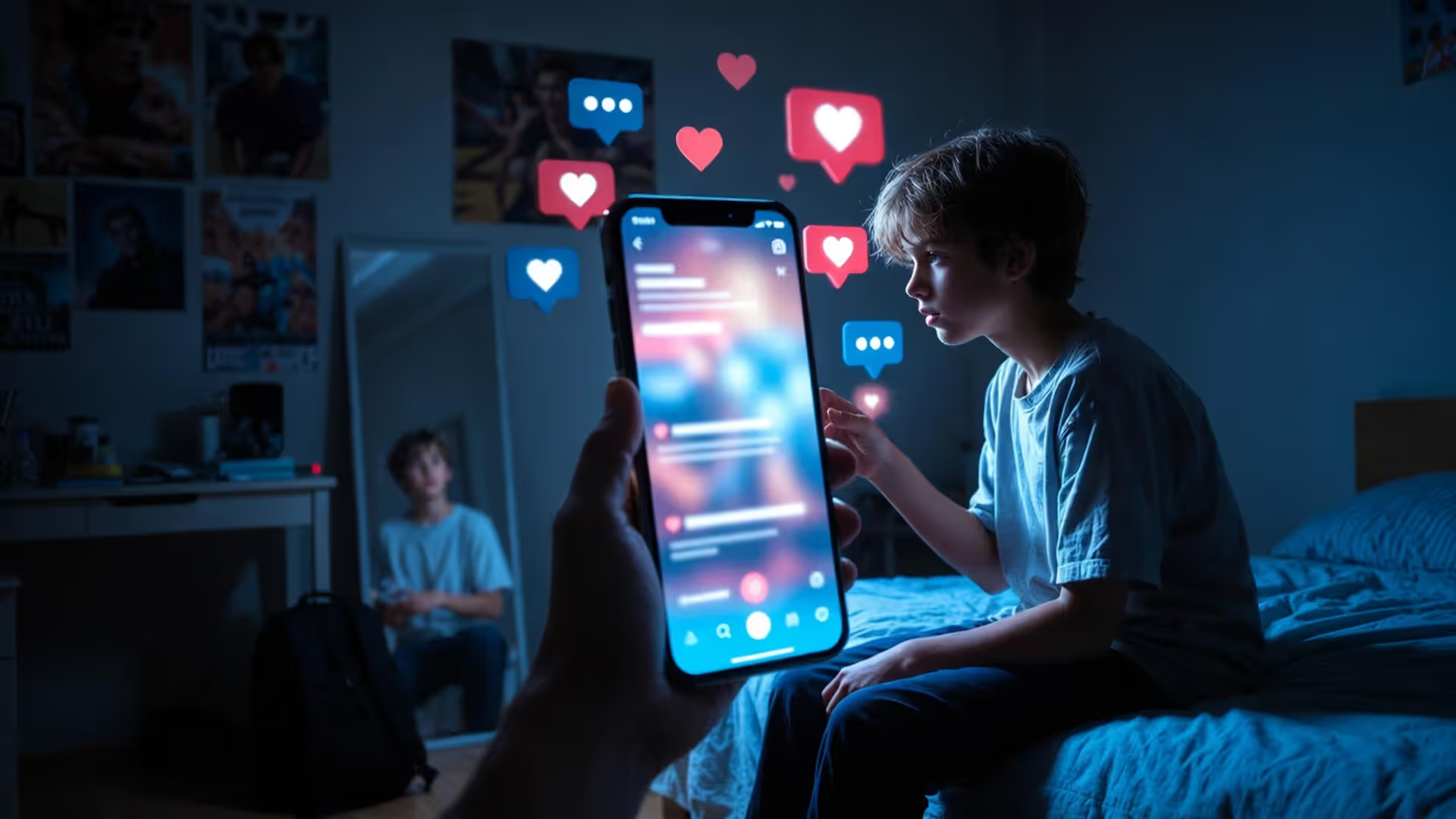
In social media environments, the mirror effect takes on unique and sometimes problematic dimensions because we have unprecedented control over our self-presentation while simultaneously being evaluated by audiences who cannot verify the accuracy of what we share. The carefully curated versions of ourselves that we present online may diverge substantially from how we experience ourselves internally, and the feedback we receive in the form of likes, comments, shares, and follower counts may create distorted impressions of how we are actually perceived by real people in our lives. Some people develop significant gaps between their online persona and their offline self, leading to confusion about their authentic identity and difficulty connecting genuinely with others who have only encountered the curated version.
The algorithmic nature of social media platforms can also create echo chambers that reinforce certain aspects of our self-image while hiding contradictory feedback, further distorting the mirror effect in digital spaces. Navigating social media thoughtfully requires awareness of how the platform shapes both our self-presentation and our interpretation of the feedback we receive, as well as recognition that online interactions provide a very narrow and often misleading window into how others actually perceive and experience us. Maintaining strong offline relationships and seeking in-person feedback remains essential for developing accurate self-understanding, as face-to-face interactions provide much richer information about how we are perceived than any online metric can offer.
Practical Strategies for Closing the Perception Gap
Beyond the foundational strategies already discussed, several additional practical approaches can help you actively close the gap between how you see yourself and how others see you. These strategies require consistent practice and genuine commitment to self-understanding, but they can lead to profound improvements in self-awareness, relationship quality, and overall life satisfaction over time.
Behavioral Experiments and Reality Testing
One powerful approach to understanding the mirror effect in your own life involves conducting small behavioral experiments where you deliberately try different approaches in social situations and observe how others respond. For example, if you believe you come across as warm and approachable but suspect others might perceive you differently, you might experiment with increasing your verbal warmth, smiling more, or asking more questions about others, then observe whether responses to you change. These experiments can reveal whether your current behavior is actually communicating what you intend, and they can help you calibrate your self-presentation to achieve better alignment between your intentions and your impact on others.
Video and Audio Self-Review
Recording yourself in various situations, whether giving a presentation, participating in a meeting, or simply having a conversation, and then reviewing the recording can provide powerful insights into how you actually come across to others. Most people are surprised when they first see or hear themselves on recording, as our internal experience of ourselves differs significantly from how we appear and sound externally. This practice can reveal mannerisms, tones of voice, facial expressions, or communication habits that you were unaware of but that significantly affect how others perceive you. While initially uncomfortable, regular self-review can help you develop more accurate self-perception and identify specific behaviors you might want to adjust.

Author: Evan Miller;
Source: psychology10.click
The Benefits of Bridging the Gap Between Perception and Reality
Reconciling how others see you with how you see yourself has numerous and far-reaching benefits for your mental health, relationships, professional success, and overall personal development. When the gap between internal and external perception narrows through intentional self-awareness and genuine engagement with feedback, you gain a more accurate and stable foundation from which to navigate life's challenges, opportunities, and relationships with greater skill and confidence.
Improved Self-Awareness and Authenticity
Aligning internal and external perceptions enhances self-awareness in ways that support more authentic living and more intentional choices about how you want to show up in the world across different contexts and relationships. When you have a clearer understanding of how others see you and where that perception diverges from your self-view, you can better adjust your behavior and communication to match your actual intentions and values. This does not mean changing who you fundamentally are to please others or becoming inauthentic in pursuit of approval. Rather, it means ensuring that who you are inside is being accurately communicated and received by those around you, so that people are responding to the real you rather than to a misperceived version. This alignment not only helps in professional settings where accurate self-presentation matters for advancement and effectiveness but also fosters healthier, more authentic relationships where people connect with who you actually are rather than who they imagine you to be.
Stronger and More Resilient Relationships
People who are more attuned to how they are perceived by others, and who actively work to understand and close perception gaps, tend to have stronger, more resilient, and more satisfying relationships across all domains of life including romantic partnerships, friendships, family relationships, and professional collaborations. This is because they are better able to navigate complex social dynamics with awareness rather than blindly, respond to feedback constructively without becoming defensive or dismissive, and avoid the accumulated miscommunications that slowly erode trust and connection over time. Understanding the mirror effect allows you to manage relationships with more empathy for how others experience you, more patience when misunderstandings occur, and more willingness to engage in the self-reflection and vulnerable conversation necessary for relationship repair and growth when things go wrong.
Increased Confidence and Emotional Resilience
When you work toward aligning how you see yourself with how others see you, your confidence naturally grows because it becomes grounded in reality rather than either inflated through denial of limitations or deflated through harsh self-criticism that ignores your genuine strengths. You will feel more competent and secure in your interactions because you have a better understanding of the actual impact you are making on others rather than relying on assumptions that may or may not be accurate. This grounded confidence leads to greater success in both personal and professional spheres, as it allows you to approach challenges with a clear and accurate sense of your genuine abilities and limitations, knowing where you can rely on yourself and where you might need support or development.
Additionally, bridging the gap between perception and reality leads to greater emotional resilience because you are less likely to be destabilized by external feedback that surprises or contradicts your self-image. When you know yourself accurately, including both your strengths and your areas for growth, and when you have integrated feedback from multiple sources into a coherent self-understanding, you can receive new feedback as useful information rather than as existential threats to a fragile self-concept. This stability allows you to remain open to growth and learning throughout your life rather than becoming defensive and closed off, which is essential for continued development and adaptation to life's changing circumstances.
The Role of Therapy and Professional Support
For many people, working with a therapist, coach, or professional counselor can be invaluable for understanding and bridging the gap between self-perception and external perception in ways that would be difficult to achieve alone. Mental health professionals are specifically trained to provide honest, compassionate feedback in ways that facilitate genuine growth rather than triggering defensiveness, and they can help you explore the psychological roots of distorted self-perception that may be difficult to access on your own due to the very defense mechanisms that created the distortion in the first place. Therapy can be particularly helpful if your self-perception was shaped by early experiences of criticism, neglect, rejection, or trauma that created inaccurate beliefs about yourself that persist despite contradictory evidence in your current adult life.
A skilled therapist can help you understand the defense mechanisms that may be distorting your self-perception, such as denial, projection, or rationalization, and can create a safe space for you to explore uncomfortable truths about yourself without judgment. They can also help you distinguish between feedback that is accurate and useful and feedback that reflects others' biases or projections rather than anything true about you. This discernment is essential because not all external perceptions are accurate, and part of healthy self-understanding involves learning whose feedback to take seriously and whose to hold more lightly. Whether through individual therapy, group therapy, or coaching, professional support can accelerate the process of developing accurate self-awareness and help you integrate new understanding in ways that lead to lasting positive change.
Conclusion: Toward a More Integrated Self-Understanding
The mirror effect is a powerful psychological phenomenon that influences virtually every aspect of our lives, from our fundamental self-esteem and mental health to our social relationships, romantic partnerships, and professional success in ways both subtle and profound. The way we see ourselves is often very different from how others perceive us, and this discrepancy can lead to painful misunderstandings, social anxiety, relationship conflicts, career setbacks, or unfounded overconfidence depending on which direction the gap runs and how we respond to discovering it. However, by actively seeking honest feedback from trusted sources, practicing regular and genuine self-reflection, embracing cognitive flexibility that allows us to update our self-concept, and developing emotional intelligence that helps us read others' responses to us, we can reconcile these differing perceptions and foster a more accurate, integrated, and grounded sense of who we truly are.
Ultimately, understanding the mirror effect allows us to live more consciously and intentionally, improving not only how we see ourselves but also how we interact with the world around us and how effectively we communicate our true selves to others. The goal is not to eliminate all gaps between internal and external perception, which would be neither possible given the fundamental asymmetry in information access nor necessarily desirable, but rather to develop keen awareness of these gaps, understand their sources and implications, and make conscious choices about how to respond to them in ways that serve our wellbeing and our relationships. When we bridge the most significant and problematic gaps between internal and external perceptions, we gain deeper self-awareness that supports authentic living, greater emotional resilience that helps us navigate life's challenges, and the ability to connect more meaningfully and authentically with others who can then know and love the real us.
The journey toward a more integrated self-understanding is ongoing and requires continuous attention, genuine humility about the limits of self-knowledge, and willingness to revise our self-concept in response to new information throughout our lives. This journey is not always comfortable, as discovering that others see us differently than we see ourselves can be surprising, disappointing, embarrassing, or even painful, particularly when the gap reveals blind spots we would rather not acknowledge. However, the rewards of this journey are substantial and worth the discomfort: a more grounded sense of self that is neither inflated by denial of our limitations nor deflated by unfair self-criticism, relationships built on authentic connection where we are truly seen and known rather than on mutual misperception, and the confidence that comes from genuinely knowing yourself and being known by others. These are essential components of a fulfilled, well-balanced, and meaningful life, and they are available to anyone willing to undertake the ongoing work of self-understanding that the mirror effect invites us to pursue.
Frequently Asked Questions
Related Stories

Read more
Read more




The content on psychology10.click is provided for general informational and inspirational purposes only. It is intended to share evidence-based insights and perspectives on psychology, relationships, emotions, and human behavior, and should not be considered professional psychological, medical, therapeutic, or counseling advice.
All information, articles, and materials presented on this website are for general educational purposes only. Individual experiences, emotional responses, mental health needs, and relationship dynamics may vary, and outcomes may differ from person to person.
Psychology10.click makes no representations or warranties regarding the accuracy, completeness, or reliability of the content provided and is not responsible for any errors or omissions, or for decisions or actions taken based on the information presented on this website. Readers are encouraged to seek qualified professional support when dealing with personal mental health or relationship concerns.